
LMS Automation and the Efficiency Dividend
How coherent learning architecture can reduce duplicated curriculum work, make implementation visible and release staff capacity for higher-value teaching.
Back to All Case StudiesA secondary school in the Hunter with a high-volume digital learning environment
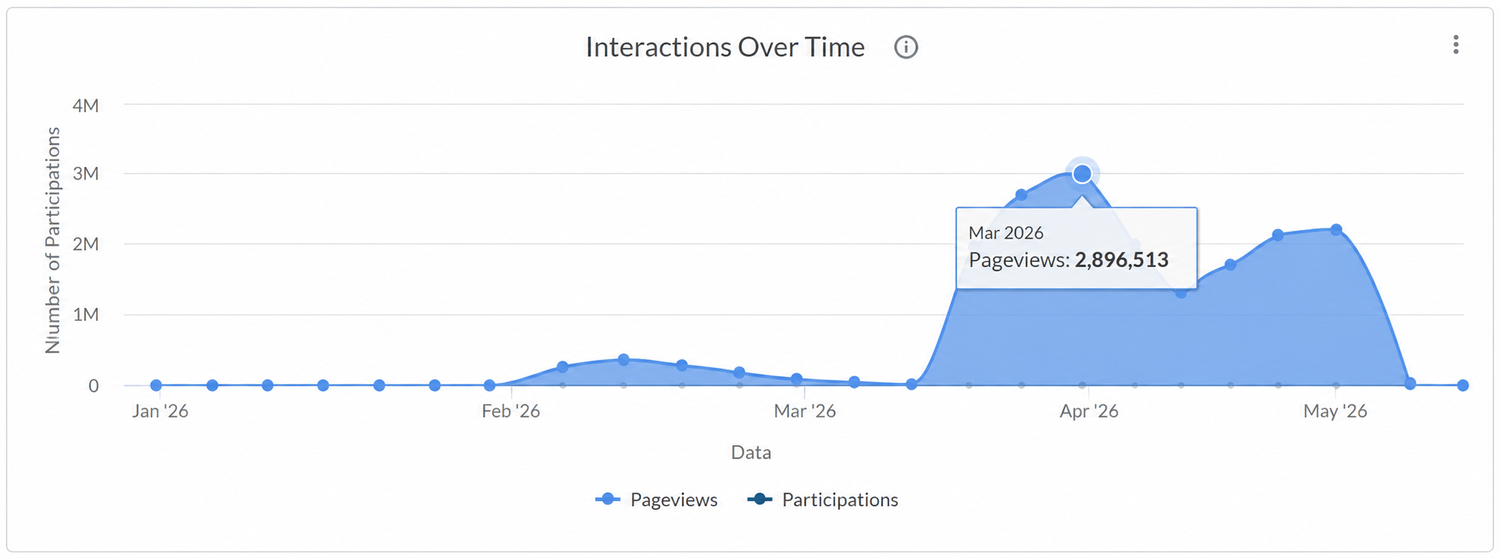
The documented operating context was a secondary school in the Hunter of approximately 1,000 students. During 2026, its LMS recorded approximately 1.6 to 2.0 million page views in typical months. This activity measure demonstrates the scale at which the architecture operated. It does not, by itself, prove learning gains or financial savings.
Whose work this was
This work was led by Core Education Design's founder in a school leadership role, not delivered as a Core Education Design engagement. It is published here as evidence of the practitioner expertise and design judgement that inform the company's approach.
The architecture, systems and materials created in that role remain the property of the school and its system. They are described here with permission, are not offered for resale, and are not licensed to Core Education Design clients. The school is not named. What Core Education Design brings to another school is the method and the judgement, not another school's assets.
Digital activity was not the same as institutional efficiency
Without common architecture, faculties and teachers can repeatedly recreate course structures, activity pages, assessment information, curriculum mapping and compliance records. Students then encounter inconsistent navigation, while leaders rely on manual checking to understand implementation.
The underlying problem was therefore not simply LMS adoption. It was the absence of a durable, school-owned operating model for curriculum delivery.
- Repeated construction of similar curriculum assets
- Inconsistent course and lesson navigation
- Manual compliance and quality-assurance workflows
- Implementation knowledge held by individuals rather than the institution
- Limited visibility for students, parents and leaders
The LMS was redesigned as institutional infrastructure
The intervention combined consistent course design, reusable curriculum structures, automated or templated workflows and AI-assisted content production. Technology supported the model, but the central work was architectural: deciding what should be consistent, reusable, visible and owned by the school.
Predictable learning pathways
Common homepages, module structures and “When, What, How” activity design reduced avoidable navigation differences between courses.
Durable curriculum assets
Templates, descriptors, assessment structures and course components were designed for controlled reuse rather than repeated reconstruction.
Implementation inside the workflow
Learning intentions, success criteria, assessment information and agreed priorities became observable within daily course use.
Standardisation was selective, not absolute
The design standardised the parts of the experience where inconsistency created workload or confusion: navigation, page structure, core curriculum information, assessment access and selected compliance workflows.
Teachers retained professional judgement over pedagogy, sequencing, explanation, interaction and adaptation for learners. The LMS supported experiential, practical and face-to-face learning rather than replacing it.
The governing distinction
Training shows staff where to click. Architecture determines whether the system preserves knowledge, reduces avoidable work and makes agreed practice easier to implement.
Documented workflow comparisons at operational scale
A cohort of approximately 75 staff used the architecture and its supporting applications. The comparisons below are before-and-after production workflows documented in professional practice in the school context described. They quantify staff capacity released, not cash returned to the school.
Source and ownership: the platform figures and activity chart below are generated by the school's learning management system and belong to the school and its system. They are reproduced here with the school's permission, in de-identified form. Core Education Design claims no ownership of them.
| Workflow | Previous staff time | Current staff time | Capacity released |
|---|---|---|---|
| High-quality learning activity | At least 3 hours for a teacher to develop a comparable activity | Approximately 20 minutes using the designed workflow and Content Creator | At least 2 hours 40 minutes per activity, before final teacher review and contextual adjustment |
| Performance-descriptor draft | A team of 2 to 4 teachers working for approximately 6 hours: 12 to 24 staff-hours | Approximately 45 minutes to produce a structured draft for professional review | Approximately 11 hours 15 minutes to 23 hours 15 minutes per descriptor set |
| Core Doc for senior-course monitoring | Approximately 8 hours to compile and maintain | Approximately 2 hours to compile and maintain using the redesigned process | Approximately 6 hours per Core Doc cycle |
| When, What, How curriculum page | Approximately 12 hours per page each year to complete and maintain | Approximately 1 to 2 hours per page each year using the common architecture | Approximately 10 to 11 hours per page each year |
How these figures were produced: they are practitioner-documented comparisons of the same production tasks before and after the redesign, recorded during normal work rather than under study conditions. They are not the output of a controlled trial, an independent audit or a verified measurement study, and a different school with different starting practice would record different figures.
A transparent annual illustration
If each of the approximately 75 participating staff uses the system to create only one high-quality learning activity and complete or maintain only one When, What, How page in a year, the documented workflow differences represent approximately 950 to 1,025 staff-hours of capacity released annually. This deliberately conservative illustration excludes additional activities, performance-descriptor work and Core Docs because their annual frequency varies by role and faculty.
The calculation is: 75 staff × (2 hours 40 minutes per activity + 10 to 11 hours per curriculum page). It is a capacity calculation, not an audited cash saving.
Efficiency was not achieved by lowering the quality bar
The redesigned workflows produced more complete, consistent and accessible resources in substantially less production time. Students and families gained reliable access to learning resources, a full year of curriculum content and personalised calendars. School leaders gained central review points from which the implementation of agreed initiatives could be observed more readily.
Strong evidence, stated with precision
What the evidence supports
Strategic LMS design improved the consistency of access to structured, accessible teaching and learning resources across the school, and the platform data confirms that the architecture operated at whole-school scale throughout the year. Families provided unsolicited positive feedback about the quality of the online learning environment, access to the full year of curriculum and personalised calendars.
What remains context-dependent
Interaction volume evidences adoption and access, not learning gain. The workflow timings are practitioner-documented comparisons, not audited measurements, and the annual total depends on how frequently each school completes the tasks. Community feedback is uncontrolled qualitative evidence collected informally, not a survey or a comparative study, and it is reported here without any claim about how other schools perform. Financial value should only be calculated from local staff-value assumptions and must not be presented as cash savings unless expenditure is demonstrably avoided.
Context boundary
This was one school, with its own staff, students, community and starting conditions, and the implementation was led from inside it rather than delivered as external consultancy. A school with different structures, capability or readiness would follow a different path and record different figures.
What this demonstrates for another school
Measure before promising
Identify high-frequency workflows, record the current baseline and test the redesigned process before calculating any school-wide benefit.
Standardise friction
Standardise elements that create avoidable workload or learner confusion, while protecting teacher judgement where variation adds educational value.
Build institutional assets
Design courses, templates and workflows so knowledge remains accessible, governable and reusable when roles, staff or syllabuses change.
The transferable principle
The opportunity is not to copy another school’s LMS. It is to identify where local digital architecture creates duplication, then redesign workflows around clarity, reuse, visibility and disciplined measurement.
Core Education Design does not guarantee that another school will achieve comparable results. What it commits to is disciplined architecture, senior practitioner judgement, defined implementation support, transparent evidence and capability transfer within the agreed scope. The scale of any improvement depends on the school’s baseline, leadership decisions, adoption and implementation discipline, and should be tested locally before it is relied upon.
Explore the architecture behind the case
Learning Architecture explains how curriculum, assessment, LMS design and implementation can be redesigned as one coherent school system.
Explore Learning Architecture