

Designing a Sustainable Alternative-Learning Campus
How curriculum, staffing, timetabling, procedures and compliance were designed as one operating model for a complex learner cohort.
A new campus required more than a new program.
An alternative-learning campus in regional NSW was established for students whose experience of conventional schooling had not produced sustained attendance, engagement or success. The campus began without an inherited local operating model, so its educational and organisational foundations had to be designed together.
The work had to reconcile three demanding frameworks: NSW curriculum and credentialling requirements, NSW Department of Education policy and governance, and the principles and methods of Big Picture Education. Flexibility could not come at the expense of rigour, safety, accountability or operational sustainability.
Whose work this was
This work was led by Core Education Design's founder in a senior campus leadership role during the three-year design and establishment phase, not delivered as a Core Education Design engagement. It is published here as evidence of the practitioner expertise and design judgement that inform the company's approach.
The campus was a collaborative achievement of its leadership team, teachers, support staff, students, families and external partners. The founder shared responsibility for translating the educational concept into curriculum structures, procedures, workflows and compliant daily operations. The outcomes reported here are not claimed as one person's work.
The model, systems and materials created in that role remain the property of the campus and its system. They are described here with permission, are not offered for resale, and are not licensed to Core Education Design clients. The campus is not named, and no endorsement by Big Picture Education or the NSW Department of Education is implied.
Core Education Design operates independently of the NSW Department of Education. Company work is undertaken outside Departmental working time and without the use of Departmental equipment, systems or resources, and does not represent the Department unless explicitly commissioned or authorised by it.
Structures were treated as educational decisions.
The timetable, staffing model, curriculum pathways, advisory relationships and evidence processes were not administrative layers around learning. Each was deliberately designed to make the intended learning model possible in daily practice.
The existing structure had stopped working for the students it served.
Re-engagement
Learning needed to become relevant, relational and connected to authentic interests and pathways without lowering expectations.
Structural coherence
Curriculum, timetable, advisory structures, portfolios, staff practice and student support had to reinforce the same model.
System compliance
Innovation had to operate inside curriculum, credentialling, governance, safety, reporting and Departmental requirements.
The design problem was not how to make conventional schooling more appealing. It was how to build a different but disciplined school structure around the needs of the cohort.
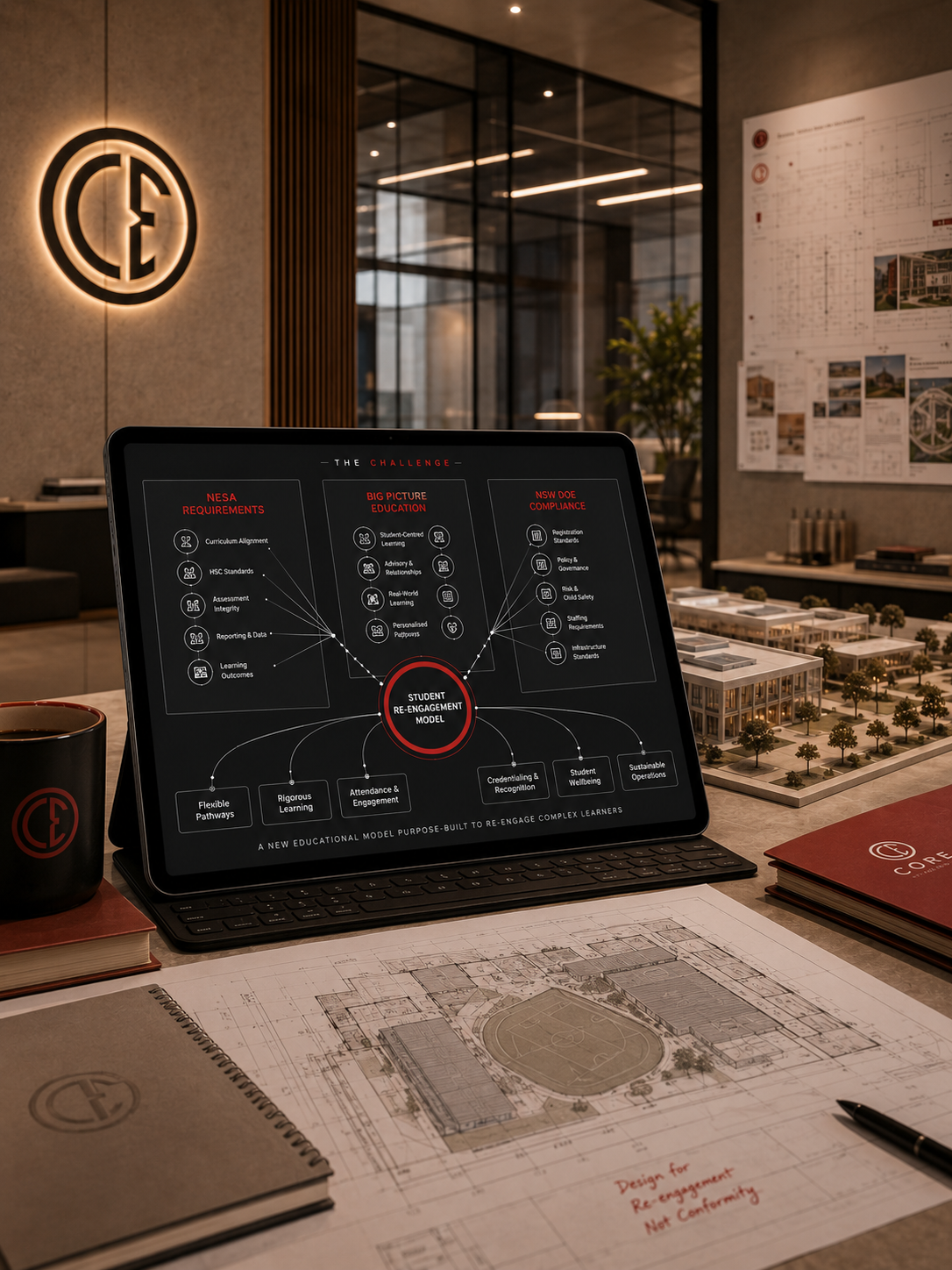
One coherent architecture rather than disconnected initiatives.
Learning design
Personalised learning plans, inquiry and project-based learning, authentic pathways and student portfolios.
Time and staffing
Timetable and advisory structures designed for deeper learning, stronger relationships and coordinated support.
Evidence systems
Digital portfolios and monitoring processes that made learning, engagement and intervention needs more visible.
Operating discipline
Procedures, staff workflows and governance aligned with curriculum, Departmental and program expectations.
The educational model was converted into repeatable daily practice.
Align the constraints
The team mapped curriculum, credentialling, Departmental policy and the intended learning model before fixing local structures.
Build the operating model
Curriculum structures, timetables, advisory arrangements, portfolio processes, monitoring routines and local procedures were developed as an integrated system.
Support consistent practice
Staff worked within shared routines for planning, student support, evidence collection, intervention and review while the model was refined through implementation.
Concrete implementation evidence included a functioning personalised curriculum structure, digital portfolio processes, advisory and monitoring routines, timetable arrangements for deep learning, and documented procedures for consistent campus operation.
Material improvement during the documented establishment period.
The available evidence relates to the three-year design and establishment phase. It combines internal operational comparisons with implementation records and practitioner observation. It does not claim that the same results continued after that period.
Source and ownership: the attendance and suspension figures are the campus's own records, held by the campus and its system. They are reproduced here with permission, in de-identified form. Core Education Design claims no ownership of them, and they have not been independently audited or externally evaluated.
Approximate attendance change for an identified group of chronically disengaged students, comparing their attendance before enrolment with attendance during the documented implementation period.
Reported reduction in suspensions relative to the comparison level, expressed as suspensions falling to approximately one-fifth of the earlier level.
Design and establishment period covered by direct involvement and by every claim made on this page.
| Evidence | What it supports | What it does not establish |
|---|---|---|
| Attendance increased from approximately 35% to 78% for the identified chronically disengaged group | A substantial improvement in participation during the documented period | That structural redesign alone caused the change, or that every student improved equally |
| Suspensions were reported at approximately one-fifth of the comparison level | A material reduction in exclusionary behaviour response during implementation | Long-term persistence after the evidence period or an isolated causal effect |
| The campus launched with curriculum, portfolio, advisory, timetable, monitoring and procedural systems in operation | Translation of an educational concept into a functioning and compliant operating model | That another campus should copy the model unchanged |
No monetary value or guaranteed outcome is inferred from these figures. Attendance and suspension data are administrative records affected by recording practice, cohort composition and local decisions as well as by the design of the campus.
Strong operational evidence, with clear boundaries.
Attribution boundary
Attendance and suspension patterns can be influenced by student mix, relationships, staffing, leadership, curriculum, intervention, community conditions and reporting practice. The case supports the value of coherent structural redesign, but does not isolate one causal variable.
Time boundary
This page makes claims only about the period covered by direct involvement and available evidence. The campus may have continued or changed after that point, but continuing success is not asserted without current longitudinal evidence.
Context boundary
This was one campus, purpose-built for a specific cohort, and the work was led from inside it rather than delivered as external consultancy. A school with an inherited structure, an existing staff culture and a general cohort faces a materially different design problem.
What this demonstrates for another school.
Redesign the system, not the student
Persistent disengagement can be a rational response to structures that do not fit the learner. Changing behaviour expectations without changing the surrounding system is usually inadequate.
Align the whole architecture
Curriculum, time, staffing, relationships, evidence and procedures must support the same intent. A new program inside an unchanged operating model will remain fragile.
Adapt principles, not templates
Another school can reproduce the design method, but its structures must reflect its own cohort, staffing, entitlement, community, facilities and regulatory context.
The transferable proposition is not that one historical campus model guarantees the same results elsewhere. It is that leaders can deliberately redesign structural conditions so pedagogy, operations and compliance stop working against each other. Core Education Design does not guarantee that another school will achieve comparable outcomes.
Our interest in this case
Core Education Design has a commercial interest in how this case is read. It is therefore presented with its context, its contribution boundary, the source of every figure and what it cannot demonstrate, so that a reader can discount it appropriately rather than take it on trust.
Examine the architecture producing your school's recurring problems.
Explore how Core Education Design aligns curriculum, staffing, timetabling, procedures and governance around a school's actual context.
Explore Organisational Architecture