
Build school systems that work in practice.
Designed to reduce workload, strengthen implementation and make learning more visible.
Core Education Design helps school leaders connect digital platforms, curriculum, AI and organisational structures so improvement becomes coherent, sustainable and easier for staff to implement.
Request a Discovery CallWhen improvement creates more complexity.
Schools rarely lack improvement initiatives. The problem is that curriculum, technology, assessment, professional learning and operational structures are often designed separately.
Staff are left to bridge the gaps manually, creating duplicated work, inconsistent implementation and systems that depend on individual effort to survive. Core Education Design helps schools redesign these elements as one coherent operating environment.
What is Educational Systems Architecture?
Educational Systems Architecture is the deliberate design of the digital, instructional and organisational systems that shape how a school operates. It connects platforms, workflows, curriculum, leadership and implementation so that improvement is practical, sustainable and easier for staff to use.
Three connected areas. One coherent approach.
The framework brings together three areas of school improvement that are too often addressed in isolation.
Schools may engage Core Education within one Architecture area or combine them where a challenge crosses multiple systems.
 Learning Architecture
Learning Architecture
Addresses fragmented LMS and course structures, inconsistent learning design and duplicated teacher workload.
Build a coherent digital learning environment that is easier to manage, navigate and sustain.
Explore Learning Architecture Intelligence Architecture
Intelligence Architecture
Addresses uncoordinated AI use, disconnected tools and uncertainty about educational value, governance and implementation.
Develop a responsible AI ecosystem designed around genuine school priorities, staff capability and controlled implementation.
Explore Intelligence Architecture Organisational Architecture
Organisational Architecture
Addresses timetables, staffing models and operating structures that restrict curriculum flexibility and educational intent.
Align organisational structures with the school’s educational vision, resources and implementation capacity.
Explore Organisational ArchitectureWhy conventional improvement efforts stall.
New initiatives are often added to existing structures without redesigning the systems underneath them.
Sustainable improvement requires more than a new platform, program or policy. It requires the surrounding system to be designed for implementation.
Fragmented systems force staff to connect processes manually.
Added initiatives increase workload without removing redundant practices.
Implementation depends on individual enthusiasm rather than embedded structures.
Timetabling, staffing and governance constraints are addressed too late.
Built for sustained implementation.
Core Education’s work is guided by four practical principles that keep strategy connected to the daily realities of schools.
Coherence
Technology, curriculum, workflow and leadership structures must work as one system.
Practicality
Every design decision must survive the realities of staff workload, capability and daily school operations.
Capability transfer
Core Education builds internal understanding and ownership so improvement does not remain dependent on an external consultant.
Evidence-informed iteration
Systems are evaluated and refined using implementation evidence, user experience and measurable operational outcomes.
The Practitioner-Leader difference.
Core Education Design is led by a practising school executive with direct experience as a principal and a career spent designing and implementing complex educational systems at scale.
This practitioner perspective keeps strategy grounded in the realities of school leadership, teacher workload, implementation, governance and sustained organisational change.
Recommendations are shaped by what can be implemented in real schools, not simply by what appears convincing in a presentation or strategic plan.
Systems that move beyond strategy documents.
Explore examples of educational architecture translated into practical implementation.
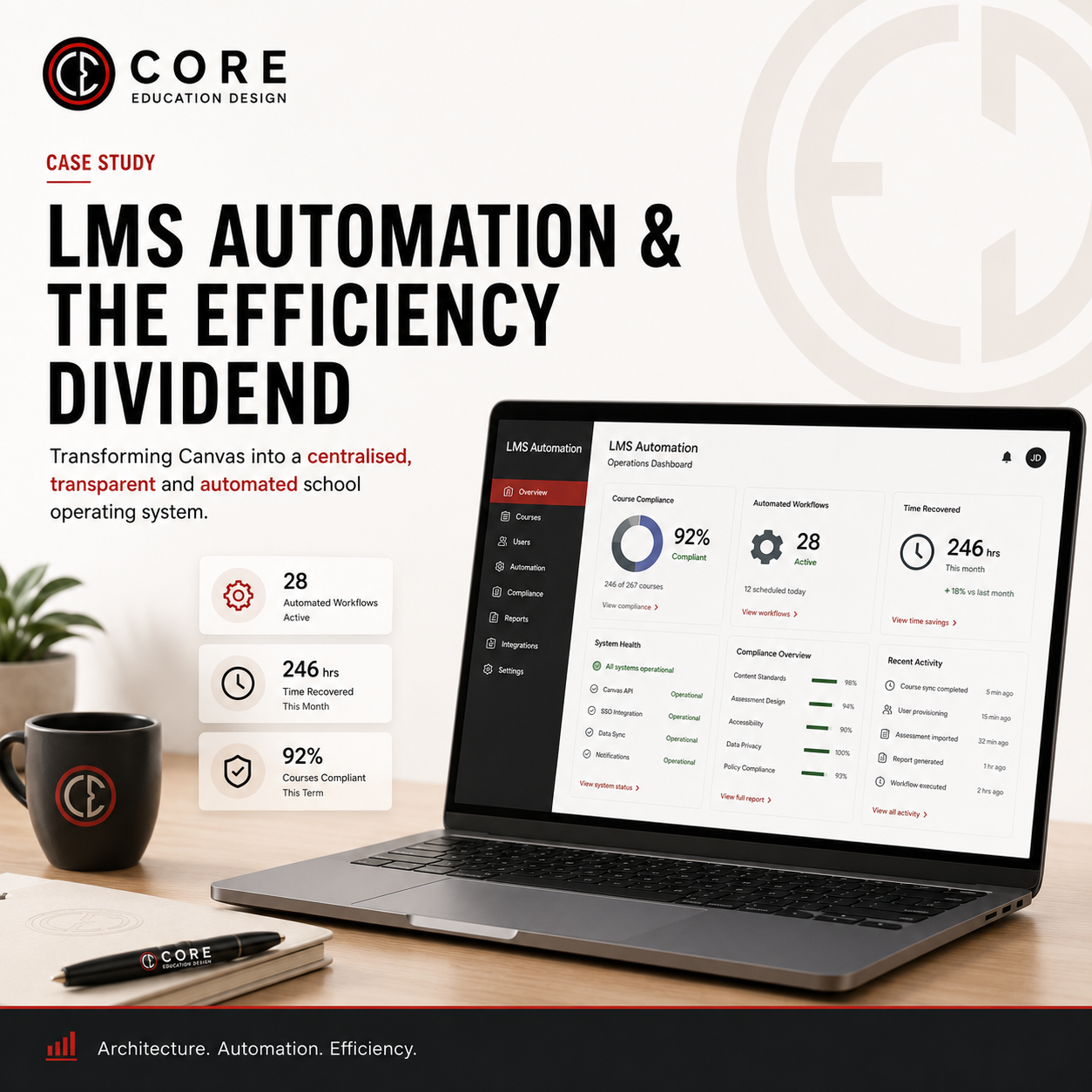
LMS Automation and the Efficiency Dividend
How purposeful LMS design reduced administrative friction and created more sustainable workflows.
Read case study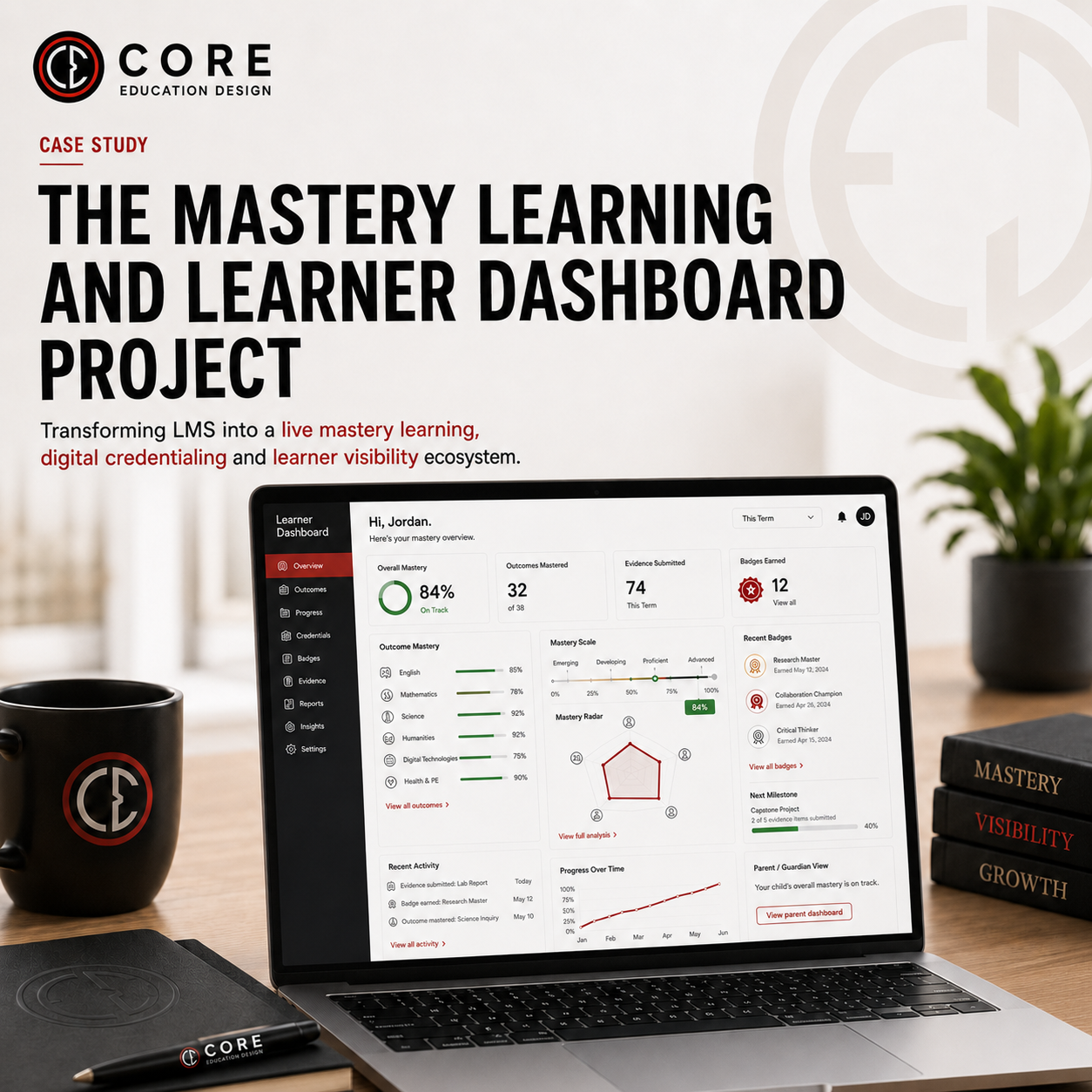
Mastery Learning and Learner Visibility
How a coherent mastery ecosystem strengthened access to meaningful evidence of learning.
Read case study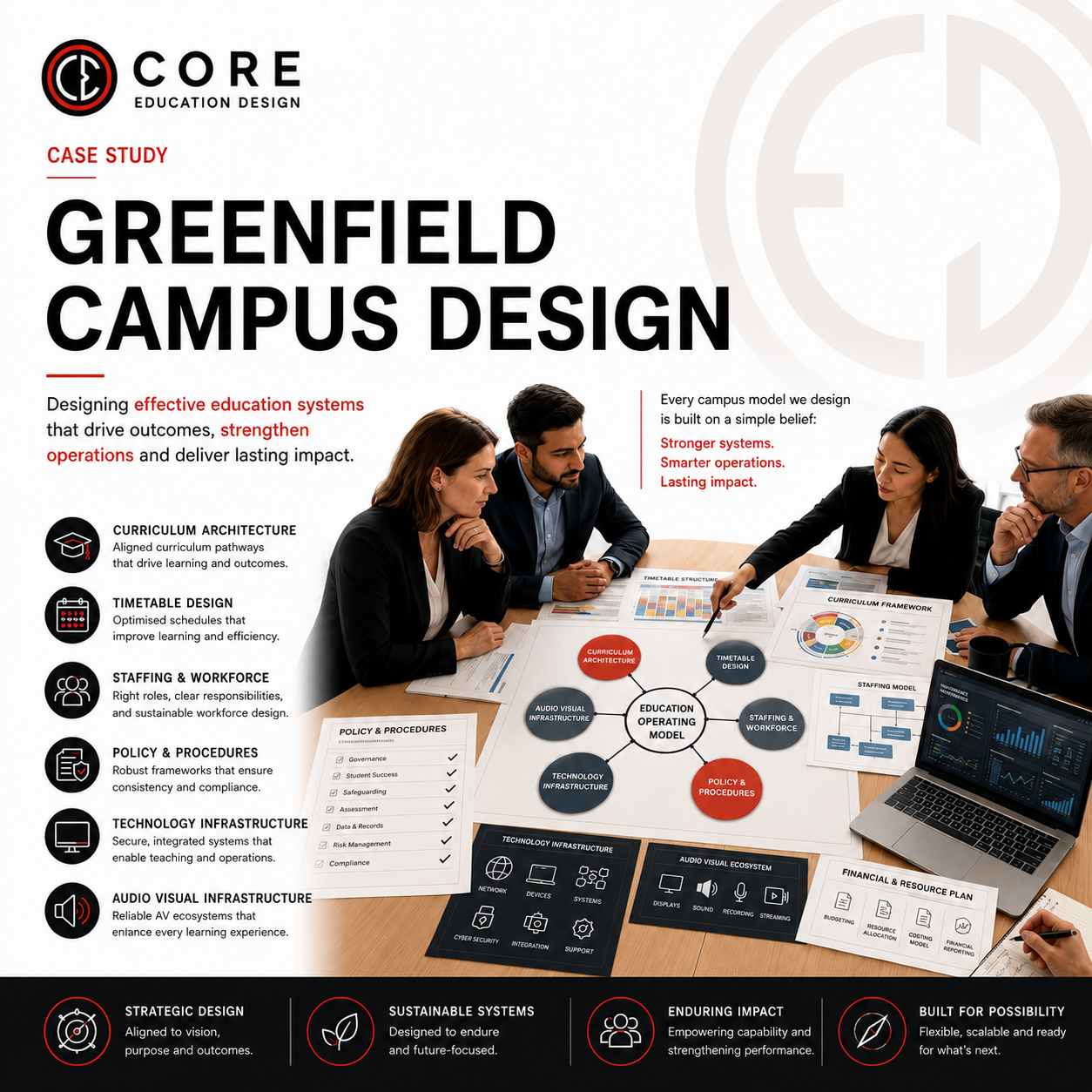
Designing a Sustainable Alternative-Learning Campus
How curriculum, staffing and operating structures were aligned to build a more sustainable learning model.
Read case studyExamples include Core Education Design engagements and practice drawn from the founder’s school leadership. All examples are anonymised unless written permission has been provided, and each case study states its own evidence boundaries.
Designed with governance in view.
Core Education designs for independence, privacy, school ownership, responsible AI use and long-term internal capability. Schools retain procurement, policy, staffing and risk-acceptance authority throughout.
Independence
Company work is separate from the founder’s public employment, and is undertaken without the use of employer time, equipment or systems.
Declared interests
Core Education receives no commission, referral fee or reseller margin from platform vendors. Where a Core Education product or licence is proposed, that interest is declared in writing.
Privacy by design
Data handling, access and platform dependencies are considered as part of implementation planning.
School ownership
Schools retain their data and locally created resources, including resources developed in Core Learning Designer, with licensing boundaries stated clearly.
Responsible AI
AI is introduced for defined educational purposes, with appropriate oversight and review.
Capability transfer
Leaders and staff are supported to understand, use and sustain the systems introduced.
Start with the problem, not a predetermined package.
Request a Discovery Call to discuss the system challenge, current constraints and the outcomes your school is seeking.
Following your enquiry, Core Education will review the information provided and contact you to arrange an initial conversation.
Request a Discovery CallCore Education Design is a registered trading name of Zenith Creative Solutions Pty Ltd, ACN 698 843 471, ABN 72 698 843 471. Corporate, insurance, independence, privacy, data, intellectual-property and service information is available to prospective clients at the appropriate procurement stage.