

Impact
Evidence matters. So do context, contribution and the limits of what the evidence can prove.
These examples demonstrate how educational systems architecture has been applied in particular school settings. They show design principles and documented outcomes, not transferable guarantees. Results in another school will depend on its people, conditions, implementation and wider environment.
Systems designed to move beyond strategy documents.
The three examples span operational efficiency, learning innovation and structural design. Each separates the school context, the problem, the intervention and the strongest available evidence so readers can judge relevance without assuming that association proves sole causation.
Three forms of system impact.
Each case is anonymised and bounded. The value lies in the design reasoning, implementation evidence and transferable principles, not in promising identical results elsewhere.

LMS Automation and the Efficiency Dividend
Context
A large secondary school managing high-volume digital learning across a complex LMS environment.
Problem
Repeated manual processes, inconsistent course structures and administrative friction consumed teacher and leadership capacity.
Intervention
Reusable architecture, automated workflows and common design standards were introduced to reduce duplication and improve visibility.
What it demonstrates
Purposeful LMS architecture can release capacity when adoption, workflow design and local conditions support it.
Headline evidence
Documented platform activity and workflow analysis indicate substantial use at scale. Any labour-capacity or financial equivalents are modelled estimates, not audited cash savings.
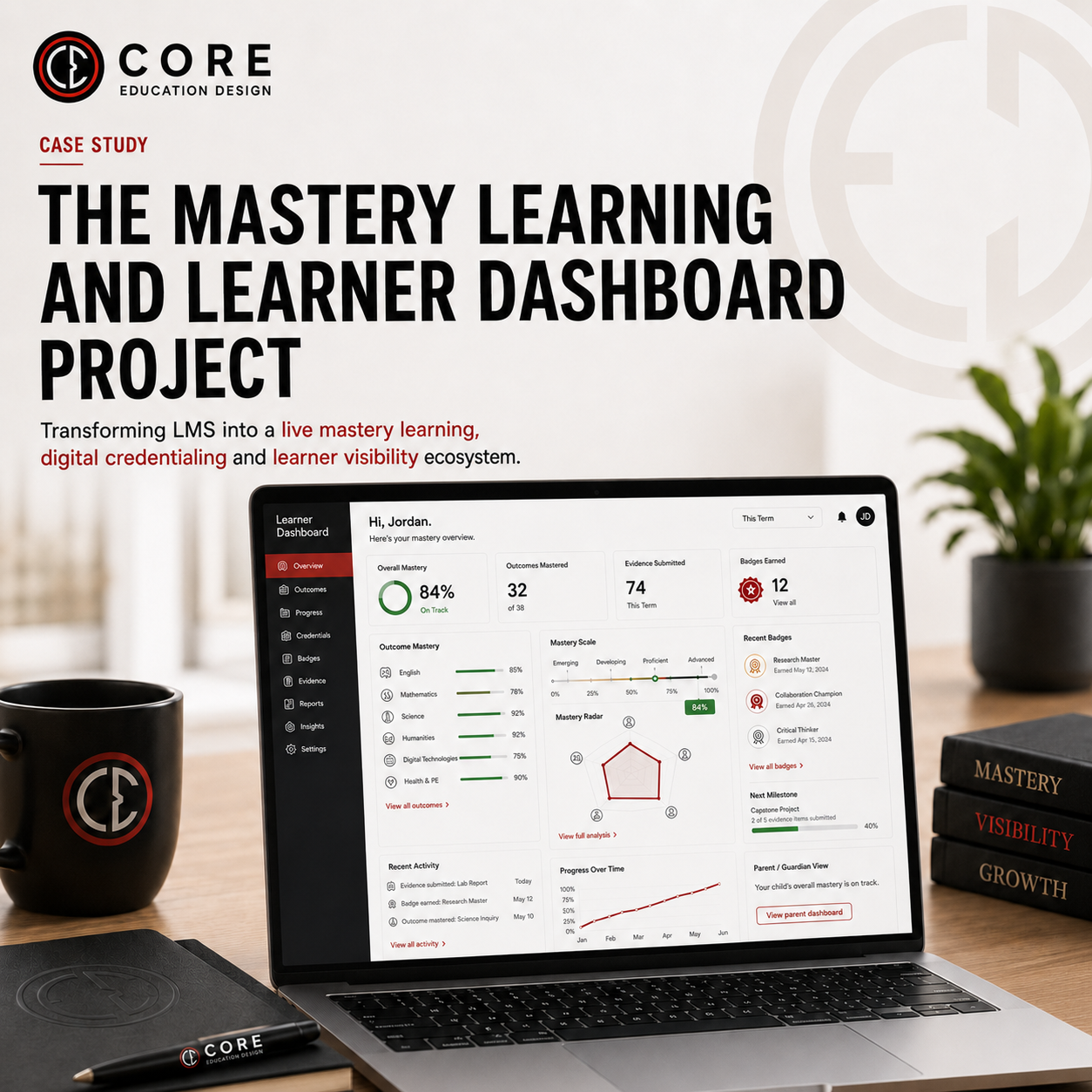
Mastery Learning and Learner Visibility
Context
A large secondary school seeking clearer, continuous evidence of student progress across multiple subjects.
Problem
Conventional grades and disconnected reporting processes offered limited visibility of what students had mastered and what remained next.
Intervention
A coordinated mastery framework connected curriculum outcomes, assessment evidence, LMS implementation and learner-facing progress information.
What it demonstrates
Learning innovation depends on aligned pedagogy, assessment, reporting and digital architecture, not a generic dashboard or AI tool.
Headline evidence
Implementation reached whole-stage curriculum coverage and sustained high LMS activity during the documented period. Activity data demonstrates adoption and access, not learning gain by itself.
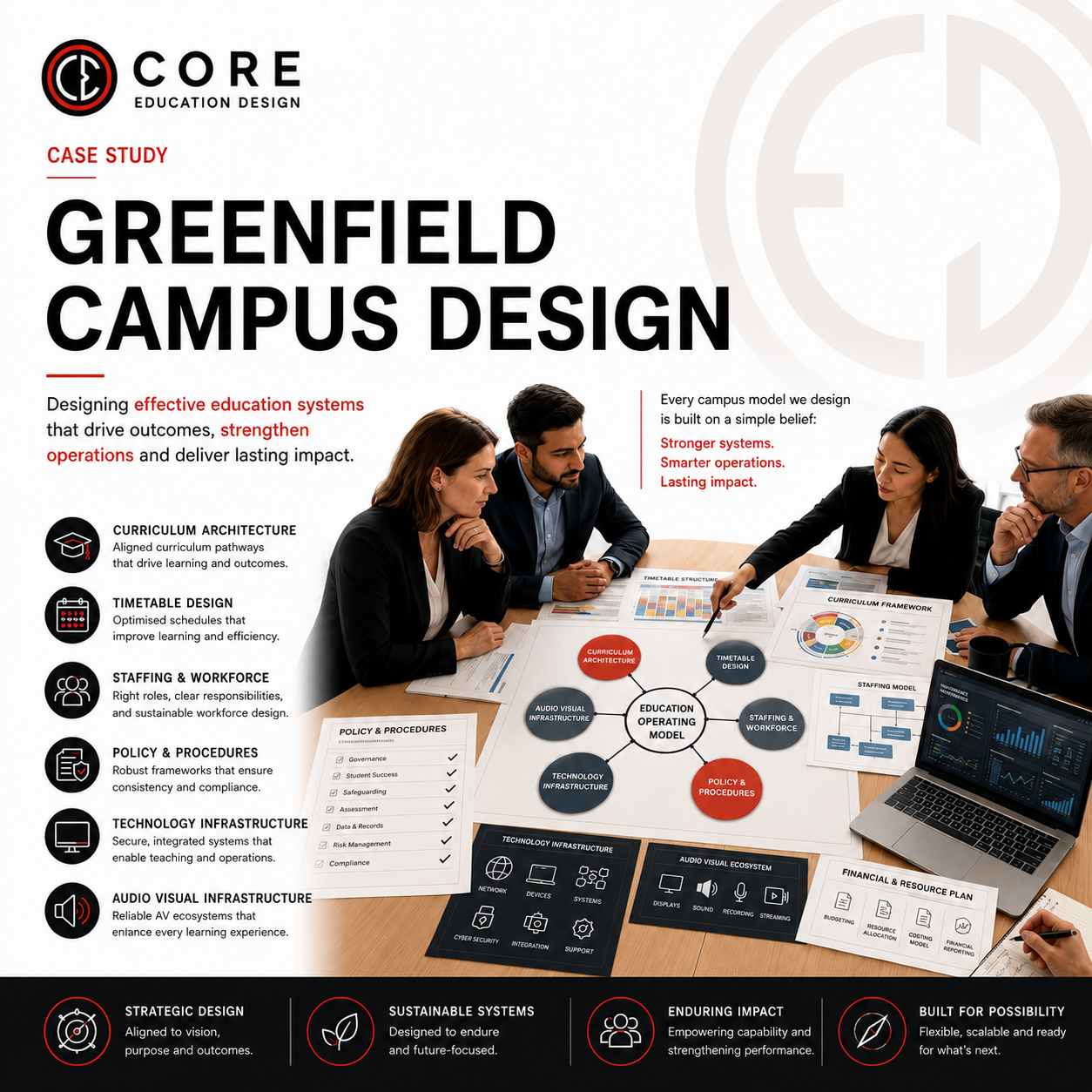
Designing a Sustainable Alternative-Learning Campus
Context
An alternative-learning campus established to serve students whose needs were not being met by the existing model.
Problem
The educational vision required curriculum, staffing, time, space, relationships and operating processes to function as one coherent model.
Intervention
The contribution covered curriculum and organisational design within a broader team-led reform implemented by leaders, staff, students, families and partners.
What it demonstrates
Structural design can make a different educational model operational when the wider school community can implement and sustain it.
Headline evidence
The documented implementation period recorded substantial improvement in attendance, engagement and behavioural indicators, as recorded in the school's own systems. These figures have not been independently verified, and the case does not attribute every outcome to one person or design decision.
Where these examples come from
These examples include engagements delivered by Core Education Design and practice examples drawn from the founder's professional experience in school leadership. Work undertaken in an employed capacity remains the property of the relevant school or system, is described only with appropriate permission, and is not offered for resale.
All examples are anonymised unless written permission for identification has been provided. Schools, campuses, staff and students are not named or described in a way intended to identify them, and results described are specific to their context.
Core Education Design has a commercial interest in how these examples are read. Each is therefore presented with its context, its contribution boundary, the type of data it rests on and what it cannot demonstrate, so that a reader can discount it appropriately rather than take it on trust.
Test what is relevant to your school.
A Discovery Call considers your context before any solution, implementation path or likely outcome is recommended.